
How Instnt insures your identity-fraud losses
Three steps, no rip-and-replace. Instnt installs like an analytics tag, underwrites the fraud loss your detection stack can’t stop, and reimburses covered losses in 30 days.
Drop in the agent
Add the Instnt agent to your onboarding flow the way you add Google Analytics — a lightweight tag, no rip-and-replace. It observes signals across identity, device, behavior, and transactions as customers sign up.
AI underwrites the loss
Every approved account is bound under a policy at approval. Instnt’s actuarially-validated model prices the residual fraud-loss risk your verification and detection stack can’t eliminate — in real time, per account.
Insured loss, reimbursed
When fraud slips through anyway, you file a claim and covered losses are reimbursed within 30 days — denial-free, backed by Munich Re and Swiss Re, each rated A+ (Superior) by AM Best.
The whole flow, end to end
A lender's own application page gets one script tag, a fixed premium is quoted and bound with reinsurance from Munich Re and Swiss Re, an insured approval returns in 287 ms, and a defaulted account is filed and paid — denial-free.
What your stack catches — and what it leaves behind
Built to slot into how you already operate
Installs like an analytics tag
No platform migration. Instnt runs alongside the identity and fraud tools you already use.
30-day reimbursement
Covered losses are paid within 30 days of a filed claim — cash flow you can plan around.
Denial-free claims
Because the evidence is captured at onboarding, covered claims are paid without the usual denial friction.
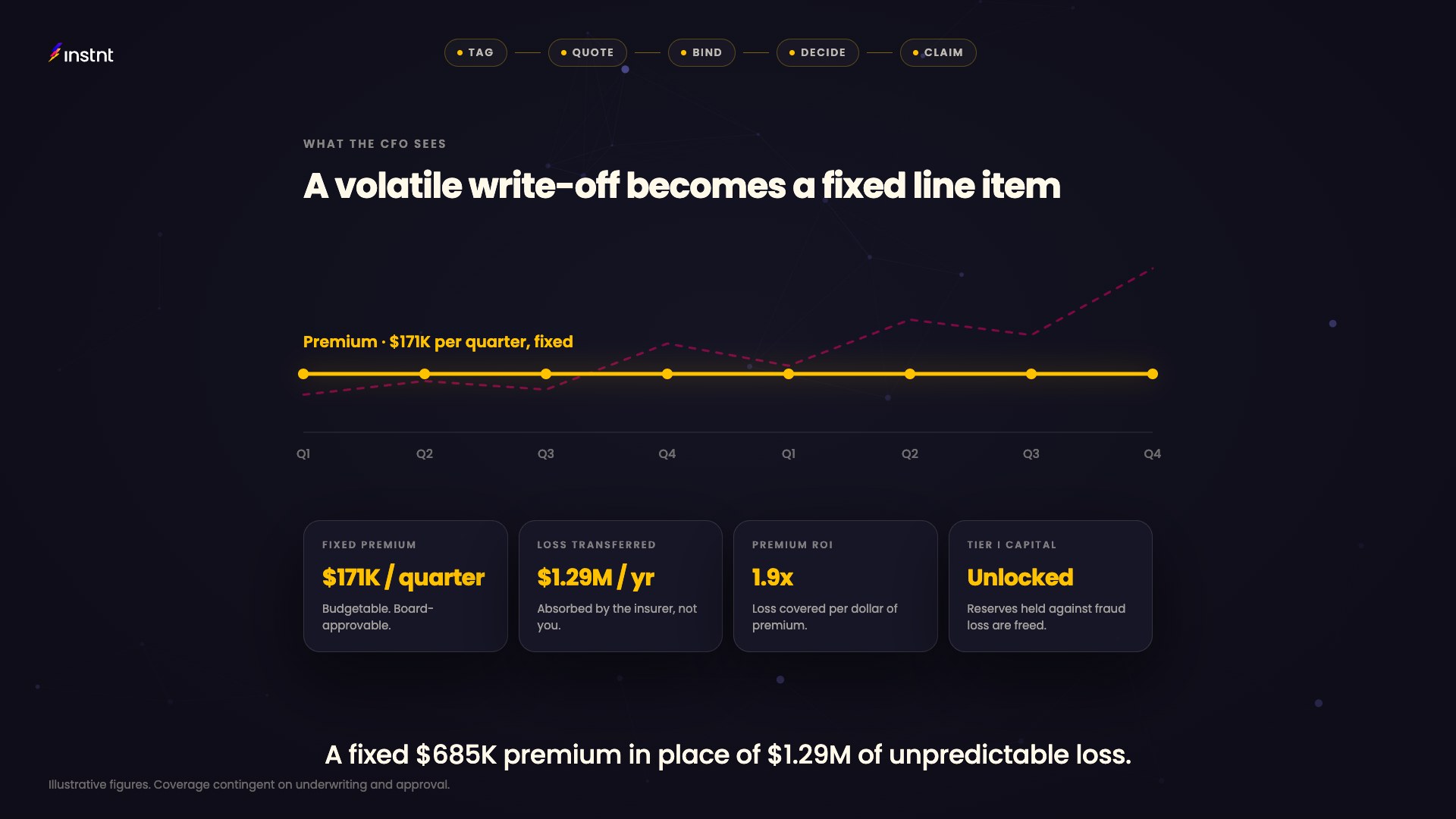
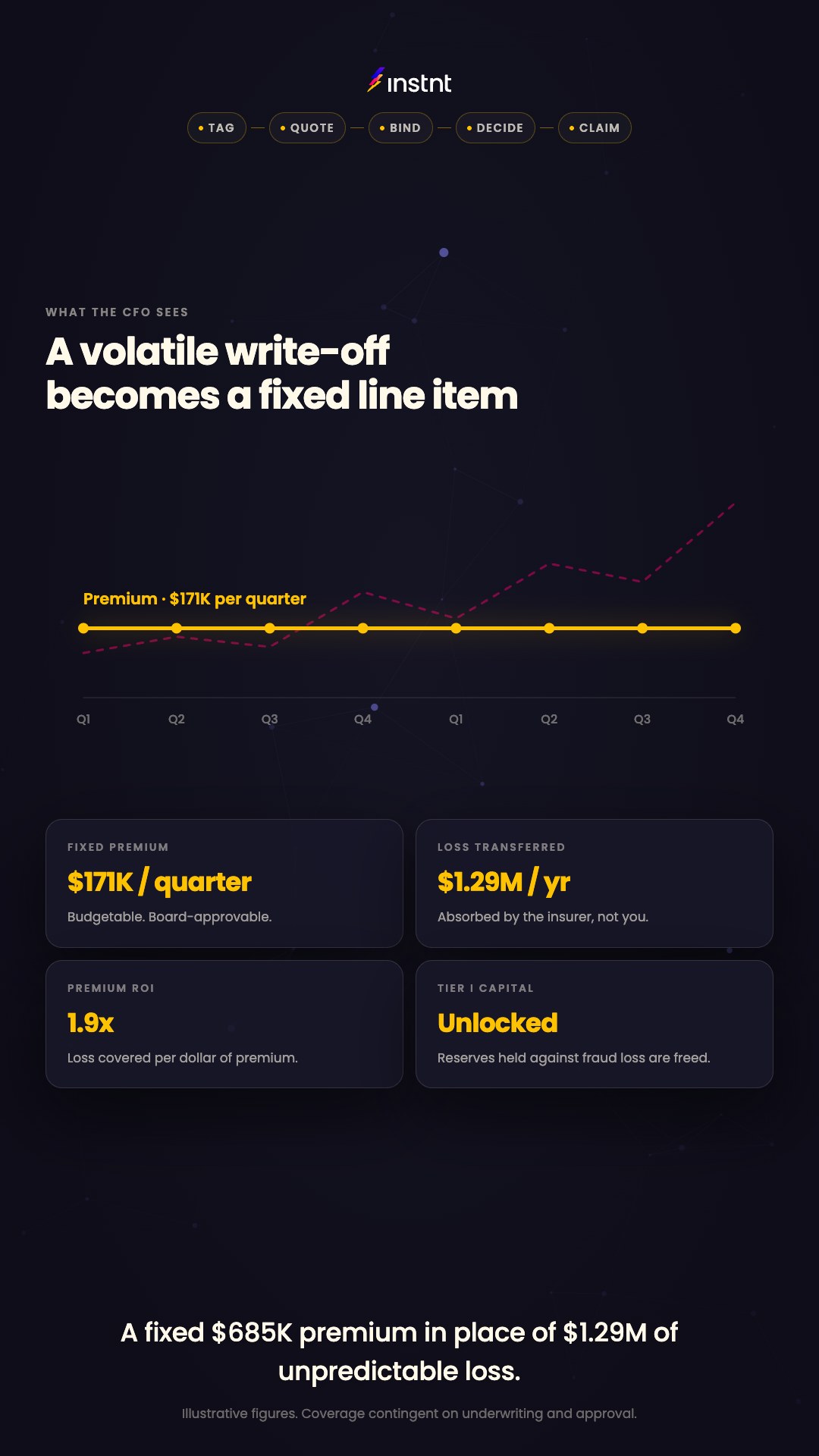
Fixed premium, not volatile loss
Replace an unpredictable write-off line with a premium your CFO can budget.
A risk score tells you whether to approve. It doesn’t pay you back when a cleared applicant turns out to be fraud. Instnt layers on top of the tools you already run and covers the loss they leave behind.
Keep Socure, Alloy, Sardine, Sift, Unit21 — whatever your stack is. Instnt prices how much fraud still gets through, and insures it.
Detection alone vs. detection + insurance
Socure, Alloy, Sardine, Sift, and Unit21 are excellent at detection. Instnt doesn’t replace them — it insures the residual loss they can’t remove, so growth no longer has to be sacrificed for safety.
Fraud is non-linear — losses don’t rise in a neat line you can reserve against. Tighten detection and you decline more good customers; loosen it and losses spike. Without insurance, the only remaining levers for safety are more reserve capital or fewer approvals.
Capital is finite and carries a cost, and every business has a limit. So a detection-only business is eventually forced to trade growth for safety. Insurance breaks that trade-off: it converts volatile, unbounded fraud loss into a fixed premium — so you can keep approving and keep growing without betting the balance sheet.
How it works — common questions
Do we have to replace Socure, Alloy, Sardine, Sift, or Unit21?
No. Instnt is not a rip-and-replace. Your verification and detection tools stay in place — Instnt prices the residual fraud risk they leave behind and binds insurance over your existing decisions. Detection reduces how often fraud happens; insurance covers the loss when it happens anyway. They are complementary layers, not competing products.
How does Instnt price our existing risk stack?
The AI ingests the same applicant signals your stack already evaluates and measures the fraud exposure that survives your current tools, thresholds, and manual-review processes. That measured, residual exposure becomes an actuarially-priced premium — so you are insuring the real gap, sized to how well your stack already performs.
Why isn’t detection alone enough?
Because fraud is non-linear and capital is finite. Detection can always be tightened, but every notch tighter also declines more good customers — and losses still spike unpredictably. Without insurance, the only lever left for safety is to hold more reserve capital or approve fewer customers. Capital is limited and carries a cost, so a detection-only business eventually has to trade growth for safety. Insurance removes that trade-off by converting volatile, unbounded loss into a fixed premium.
What is the liability gap?
The liability gap is the difference between the fraud your detection tools catch and the fraud loss your business ultimately absorbs. Every scoring model has one. Instnt closes it by reimbursing covered losses within 30 days, backed by Munich Re and Swiss Re, each rated A+ (Superior) by AM Best — without asking you to change the tools you rely on.
Does adding insurance let us approve more customers?
Yes. When residual losses are underwritten and reimbursable rather than feared, teams can safely raise approval rates instead of over-declining to protect the balance sheet — recovering the revenue that defensive thresholds quietly cost today.
Ready to see it on your onboarding flow?
We’ll walk your team through the drop-in agent and size your insured recovery.