After Synapse: Who Owns the Loss?
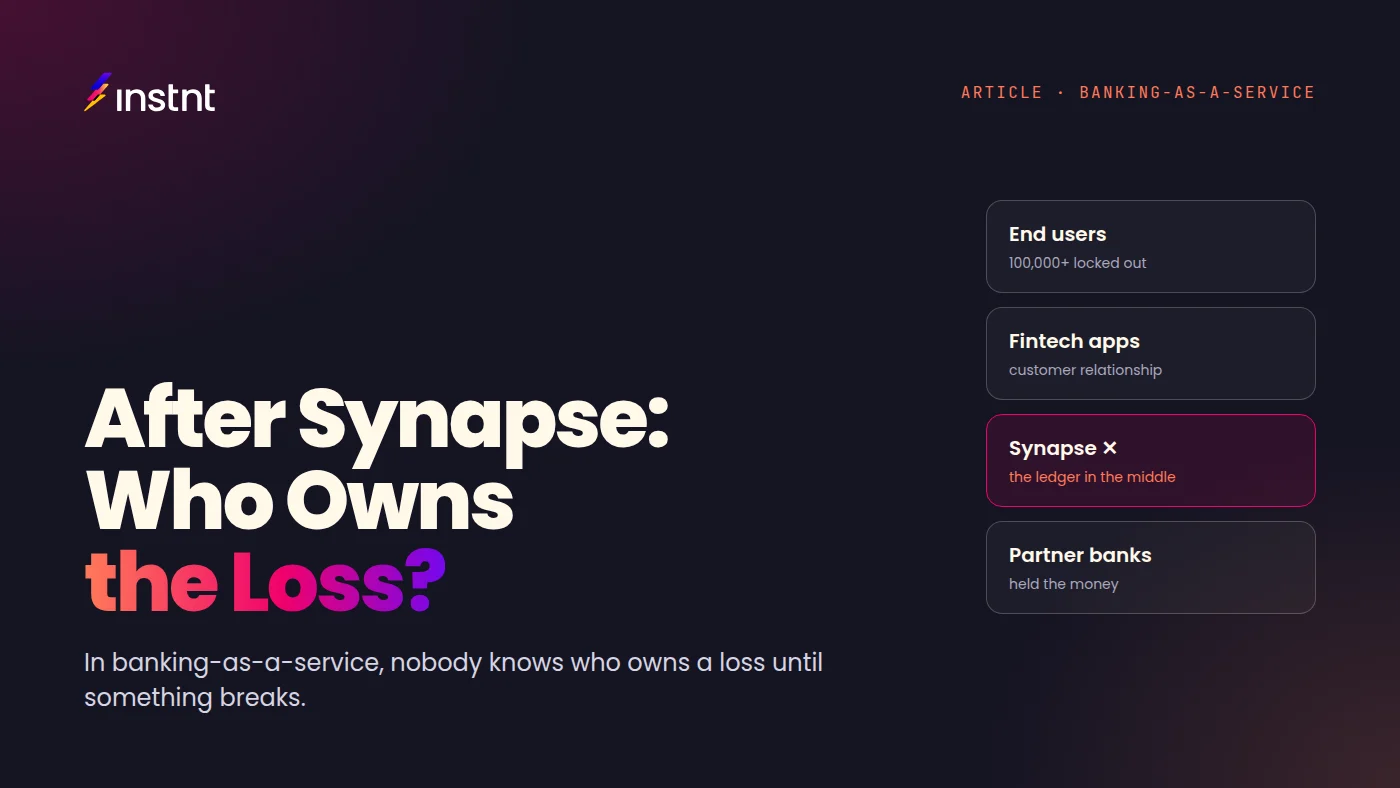
More than 100,000 people lost access to their money in 2024, not because a bank failed, but because nobody could say whose ledger was right. For sponsor banks, the lesson reaches well past reconciliation.
- 100,000+ end users locked out of their accounts in 2024.1
- $65–96M shortfall the trustee estimated between funds owed and funds held.2
- $1 CFPB civil penalty that opened the Civil Penalty Fund to victims.3
1. A ledger in the middle
Synapse sat between fintech apps and the banks that held their customers’ money. The apps, among them Yotta, Juno and Copper, owned the customer relationship. The banks, Evolve, Lineage, AMG National Trust and American Bank, held the deposits, often in pooled accounts for the benefit of end users.4
Synapse kept the record of who owned what. The money sat at the banks; the record of whose money it was sat at Synapse. When Synapse and Evolve fell into dispute and Synapse entered bankruptcy, the record and the money came apart.
Banking Dive reported that more than 100,000 customers were locked out.1 The trustee’s filings put the gap between what end users were owed and what the banks held in the tens of millions, and said the source of the shortfall was not known.2 By the trustee’s count in June 2024, end users were owed $265 million against $180 million held.1
Timeline
- April 22, 2024. Synapse files for Chapter 11 in the Central District of California after a dispute with partner bank Evolve Bank & Trust.5
- May 11, 2024. The dashboard goes dark. The system Synapse provided Evolve to maintain customer accounts stops working, and access at affected fintech apps is cut off.6
- May 24, 2024. Former FDIC Chair Jelena McWilliams is appointed trustee after a planned sale collapses.7
- June 2024. The trustee estimates the hole at $65 million to $96 million between what end users are owed and what the banks hold.2
- June 14, 2024. The Federal Reserve acts against Evolve over risk management of its fintech partnerships.8
- July 25, 2024. Joint agency statement: the bank remains responsible for compliance, however functions are shared with third parties.9
- September 12, 2025. CFPB judgment against Synapse: a $1 penalty that makes victims eligible for the Civil Penalty Fund.3
- November 12, 2025. The bankruptcy case is dismissed.10
- September 11, 2026. The agencies propose rescinding the 2024 statement as part of new third-party risk guidance.11
2. Not the banks. Not the FDIC.
The four partner banks returned the money they could match to owners. American Banker reported more than $187 million returned, about 85 percent of the $219 million held as of May 2024.12 What they would not do was cover the difference. Evolve’s position was that it could only return end users’ funds it held.12
Deposit insurance did not apply either. Pass-through coverage protects depositors against the failure of an insured bank. No bank failed here. The money was simply unaccounted for in a non-bank’s records.
“FDIC insurance will not play a role here, will not make you whole.” Jelena McWilliams, Chapter 11 trustee12
That left the end users. In 2025 the CFPB sued Synapse and took a stipulated judgment with a $1 civil money penalty, a mechanism that lets the Bureau draw on its Civil Penalty Fund, money collected from other companies’ violations.3 It has allocated about $55.2 million for Synapse victims across two allocations. As of September 2026 that money had not yet been paid out, and Banking Dive reported thousands of end users still out as much as $95 million, some pursuing small-claims cases against Evolve.13 A class action filed in Colorado federal court in November 2024 names all four partner banks.4
3. Guidance can be rescinded. Liability can’t.
Synapse landed in the middle of an enforcement wave already under way. Castellum.AI found that 18.3 percent of federal enforcement actions from January to August 2024 targeted banking-as-a-service banks, against 13.5 percent in 2023 per S&P Global data.14 Banking Dive’s running list of 2024 BaaS consent orders includes Blue Ridge Bank (OCC, January), Lineage Bank (FDIC, January), Sutton Bank (FDIC, February), Piermont Bank (FDIC, February), Mode Eleven Bancorp (Federal Reserve, March), Thread Bank (FDIC, May) and Evolve Bank & Trust (Federal Reserve, June).15 The Federal Reserve’s June 2024 order against Evolve found unsafe and unsound practices in the management of its fintech partnerships and requires prior approval before it takes on new fintech partners or products.8
In July 2024 the agencies stated the principle plainly: regardless of whether functions are shared with a third party, the bank remains responsible for compliance with applicable requirements.9 The FDIC proposed a recordkeeping rule for custodial accounts with transactional features, aimed at exactly the ledger gap Synapse exposed; it has not been finalized.16
The mood has since shifted. On September 11, 2026, the OCC, Federal Reserve, FDIC and NCUA proposed new third-party risk guidance that would rescind the 2024 statement.11 Some sponsor banks will read that as relief. It is not a transfer of risk. The deposits are still on the bank’s balance sheet, a class action filed in November 2024 names the banks, and the losses in a program still land somewhere. Guidance changes the supervisory emphasis, not where the loss lands.
4. The question Synapse asked applies to every loss
Synapse was a reconciliation failure, not a fraud event. But the structural question it forced, who absorbs a loss in a three-party program, is the same one sponsor banks face every day on a far more frequent loss: fraud. Synthetic identities opening accounts, account takeover, first-party bust-out. Many program agreements assign it to the fintech. Whether the fintech can pay is a separate question, and the answer only arrives when something breaks.
Lawyers who draft these agreements say it directly: ambiguity in loss allocation is a frequent source of post-dispute litigation, and shifting BSA/AML work to a fintech does not relieve the bank of its regulatory duty.17 Regulators have already held a sponsor bank to account for fraud that ran through a partner program. In 2023 the Federal Reserve and NYDFS fined Metropolitan Commercial Bank nearly $30 million combined, after prepaid accounts it opened through a fintech program were used to collect illegally obtained unemployment benefits; NYDFS put the misdirected total above $300 million.18 And before middleware provider Solid failed in 2025, its partner Lewis & Clark Bank had required a $10 million security reserve in 2023 and later gave notice to end the relationship.19
The loss map every sponsor bank should be able to fill in
| Loss event | Named payer | Funding source | Evidence for an examiner |
|---|---|---|---|
| Ledger break or reconciliation gap | |||
| Identity fraud at onboarding | |||
| Disputes, chargebacks, negative balances | |||
| Partner insolvency |
Where a cell reads “the fintech,” the next question is what funds that promise.
5. Name the payer before the loss
Synapse will not be the last program failure, and the next one may start with fraud rather than a ledger. The institutions that come through it will be the ones that already know who pays for each kind of loss and how that payment is funded.
- Map every loss type to a payer. Ledger breaks, identity fraud, disputes, negative balances and partner insolvency, each with a named party and a named funding source.
- Hold your own ledger. Daily reconciliation at the end-user level, in systems the bank controls, is the lesson the FDIC’s recordkeeping proposal was written around.
- Size reserves to the loss, not the relationship. Collateral and reserve accounts should track the program’s actual loss exposure, and grow as volume does.
- Fund the fraud piece before it happens. A contractual promise from a thinly capitalized partner is not a funding source. Identity fraud loss can now be insured, subject to underwriting and policy terms, which names the payer before the loss.
Instnt places identity fraud loss insurance for banks, credit unions, lenders and fintechs, with capacity from Munich Re and Swiss Re, each rated A+ (Superior) by AM Best. Coverage is contingent on underwriting and approval. Get a free fraud loss assessment or a quote.
Footnotes
-
U.S. Senate Committee on Banking, Housing, and Urban Affairs, press release, July 1, 2024, citing the trustee’s $65 million to $96 million estimate; Banking Dive, June 12, 2024. ↩ ↩2 ↩3
-
CFPB, stipulated final judgment, Synapse Financial Technologies, Inc., September 12, 2025; CFPB Civil Penalty Fund allocations of $46,248,291 (Nov. 28, 2025) and $8,965,767 (May 29, 2026). ↩ ↩2 ↩3
-
Banking Dive, November 2024 (class action filed in U.S. District Court, District of Colorado). ↩ ↩2
-
Evolve Bank & Trust, statement on Synapse bankruptcy, July 12, 2024; CFPB enforcement action page, Synapse Financial Technologies, Inc. ↩
-
The American Prospect, “The Fintech Fight That Froze Bank Accounts,” May 23, 2024. ↩
-
Fintech Business Weekly, “The Synapse-Evolve Disaster, One Year Later,” April 20, 2025. ↩
-
Board of Governors of the Federal Reserve System, enforcement action against Evolve Bancorp and Evolve Bank & Trust, June 14, 2024. ↩ ↩2
-
Federal Reserve, FDIC and OCC, Joint Statement on Banks’ Arrangements with Third Parties to Deliver Bank Deposit Products and Services, July 25, 2024. ↩ ↩2
-
Banking Dive, “Synapse bankruptcy case tossed,” November 14, 2025. ↩
-
Federal Reserve Board press release and interagency proposed third-party risk management guidance (OCC, Federal Reserve, FDIC, NCUA), September 11, 2026. Proposal. ↩ ↩2
-
American Banker, “Evolve Bank update, fresh lawsuit in Synapse bankruptcy,” December 2, 2024; American Banker, “4 reasons banks are unlikely to make Synapse end users whole,” December 9, 2024. ↩ ↩2 ↩3
-
Banking Dive, September 17, 2026. ↩
-
Castellum.AI, “Analysis: BaaS Enforcement Actions 2024,” September 9, 2024. ↩
-
Banking Dive, “A running list of BaaS banks hit with consent orders in 2024,” updated December 18, 2024. Cross River Bank’s FDIC order dates to 2023. ↩
-
FDIC, proposed rule on recordkeeping for custodial accounts with transactional features (RIN 3064-AG07), October 2, 2024. ↩
-
Shumaker, Loop & Kendrick, via National Law Review, August 14, 2026. ↩
-
Federal Reserve Board, enforcement action against Metropolitan Commercial Bank, October 19, 2023; NYDFS consent order, October 2023. ↩
-
Banking Dive, April 2025 reporting on Solid Financial Technologies’ bankruptcy. ↩