The Risks and Rewards Conversation at Fintech Meetup
At the end of March, our team was in Las Vegas for Fintech Meetup at Mandalay Bay. The cards, it turned out, were in our favor. If you’ve never been to Fintech Meetup, the format is unlike that of most conferences. Every meeting is pre-scheduled, every conversation has a clock, and the people across the table have already decided they want to be there. That makes for fifteen minutes of real talk with no room for filler, and the meetings stacked up fast. The theme in nearly every meeting and hallway conversation we had was that fraud is inevitable, and the industry is still searching for smarter ways to manage it. What we kept finding is that identity fraud insurance was not yet on most people’s radar, and once it was, the conversation changed entirely.
The conversation everyone was having
What struck our team at Fintech Meetup was how universal the frustration with fraud was, across institutions, use cases and business models. The specifics and the scale varied, but the underlying problem was the same at every table we sat at.
Trevor, our Sales Executive, described it well: “Everybody seems to agree that fraud is inevitable. And everybody is focused on how to do digital banking business better. There’s a spectrum from ‘not digital’ to ‘fully digital,’ and most people are somewhere in between, trying to figure out where they want to end up without losing their shirt to identity fraud.”
That spectrum was something we saw play out in real time across our meetings. Some institutions were deep into digital transformation, others were just beginning, but nearly all of them were grappling with the same ceiling: how do you grow and modernize without absorbing catastrophic identity fraud losses along the way? The conversations were candid in a way that only happens when everyone in the room is dealing with the same thing and knows it.
Financial institutions are advancing their digital capabilities at pace, but fraud risk is the ceiling they keep hitting. Most attendees had sophisticated fraud prevention strategies. Far fewer had considered what happens after the loss.
Jim McCarthy, our partner and founding member of the CFPB, was in the meetings with us. His biggest takeaway from the floor was the sheer volume of money being spent on fraud prevention. Thousands of vendors, all focused on reducing fraud exposure. What struck him just as much was how fraud is accounted for differently outside the bank and credit union space. Non-bank lenders and small dollar lenders take losses directly to loan loss rather than drawing from dedicated fraud reserves, which makes quantifying insurable amounts a more complex conversation.
That gap is exactly where Instnt lives.
Why identity fraud insurance kept coming up
Amy, our SVP of Sales, had her own full slate of speed dates throughout the day. In one conversation that stuck with her, an attendee arrived at the value proposition entirely on her own: “I can reduce my friction and have growth.” That was a customer stating a business outcome, unprompted.
Amy reflected: “A lot of people don’t know that there is insurance for identity fraud loss. That, in itself, was often a revelation.”
She also noted something that came up more than once: some attendees walked into the meeting with no idea who we were, while others came fully prepared and already understood what Instnt does. The range was wide, but in both cases the insurance conversation landed. Whether someone needed the full explanation or just confirmation of what they suspected, the reaction was consistently the same: genuine interest.
What we heard repeatedly, and what our fireside chat during the happy hour made clear, is that identity fraud loss insurance changes the balance sheet math as well as recouping losses.
Sunil Madhu, our CEO and Founder, walked through the economics during the fireside chat. A premium covers identity fraud losses that get through, and it can also release capital held in reserve against those losses and reduce the operating cost of managing fraud. How large each effect is depends on the institution’s own loss data and its quoted premium, which is indicative until underwriting.
When people heard that framing, the common response was: “That sounds too good to be true.”
Our answer: the balance sheets backing Instnt are Munich Re and Swiss Re, each rated A+ (Superior) by AM Best. That is how insurance is supposed to work.
Amy put the business case plainly: “A lot of companies think about their profitability. Insurance is a great choice for improving it. You can utilize the capitalisation you have in reserves, replace it with insurance, reduce op-ex costs, and aside from just solving for identity fraud loss, all of those additional costs affect margins. Acting on insurance now not only helps pick up after identity fraud losses, but more importantly, improves overall profitability.”
The moment that stayed with us
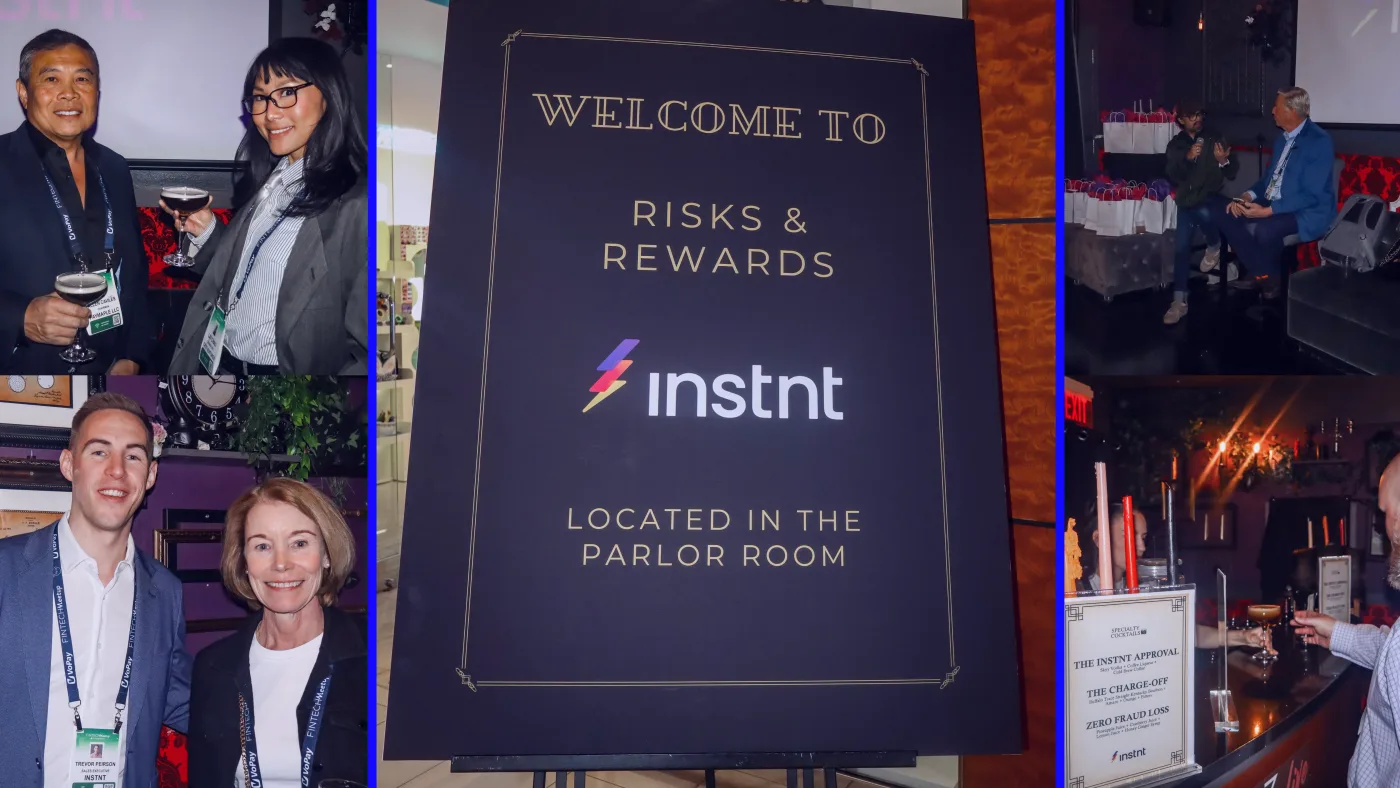
At our happy hour at 1923 Prohibition, attendees sipped on “The Instnt Approval,” “The Charge-Off,” and the crowd favorite “Zero Fraud Loss.” What stood out was the quality of the conversations happening throughout the room.
“Zero Fraud Loss” was the most ordered drink of the night. It was also not coincidentally one of the most talked-about topics in the room.
The fireside chat drew a genuinely captivated audience as we walked through the rainy-day fund problem: most financial institutions already set aside capital reserves for expected identity fraud losses. They’ve essentially pre-funded the loss. Insurance replaces that self-insurance model with a product that costs a fraction of the reserve, and unlocks the rest of that capital for growth. The audience was engaged, asking questions, pushing back in the best way, and the dialogue that followed made clear just how much appetite there is for a smarter approach to managing fraud risk.
Amy observed: “People at the cocktail hour truly wanted to hear what we were doing. They genuinely engaged in conversations, and when people left, they stopped by to tell us they’d had great conversations inside.”

That energy carried through to dinner at Bourbon Steak, where a smaller group continued the conversation well into the evening. The setting shifted, the pace slowed down, and the conversation went deeper. That’s the part of conferences that rarely makes it into the recap but often matters most, when the agenda is gone, and people are just talking honestly about what they’re facing and what they’re looking for.
What happens next
For us Fintech Meetup doesn’t end when the last meeting wraps up. This was just a starting line.
Trevor reflected on what the follow-through looks like: “People said, ‘This is interesting, and we’d like to continue the conversation.’ They’re pursuing a quick quote or a preliminary quote to understand what it would cost to insure their identity fraud losses.”
That’s the signal we were looking for. The fact that institutions are moving toward quotes means the education piece is landing, and the business case is holding up under scrutiny. Amy echoed that: “We’re already seeing success. We have follow-up meetings. We will probably progress forward with deals. Fintech Meetup is one of the best conferences for getting in front of someone and having a meaningful 15-minute discussion.”
Jim put it plainly: “While everyone was talking about how to reduce fraud, we were introducing a concept of transferring the risk off the balance sheet. We were the diamond in the rough. The reaction was overwhelmingly positive and if we can get done what we hope to get done, it will change the industry.”
The question the industry hasn’t fully answered yet: as digital banking scales and identity fraud scales with it, what’s the sustainable model for managing that risk? Prevention alone isn’t enough, and self-insuring via reserves is expensive, inefficient, and capital-intensive. The conversations we had in Las Vegas confirmed that more and more institutions are ready to ask that question out loud, and ready to hear a real answer. We left Las Vegas with follow-up meetings on the calendar and a clearer sense of where the industry’s head is at and how Instnt fits into where it’s going.
Curious about the economics? Reach out to our team or get a quick quote. The math might surprise you.